Day of the Dead and Samhain 2026: How to Make an Ofrenda and a Ritual to Honor Your Ancestors
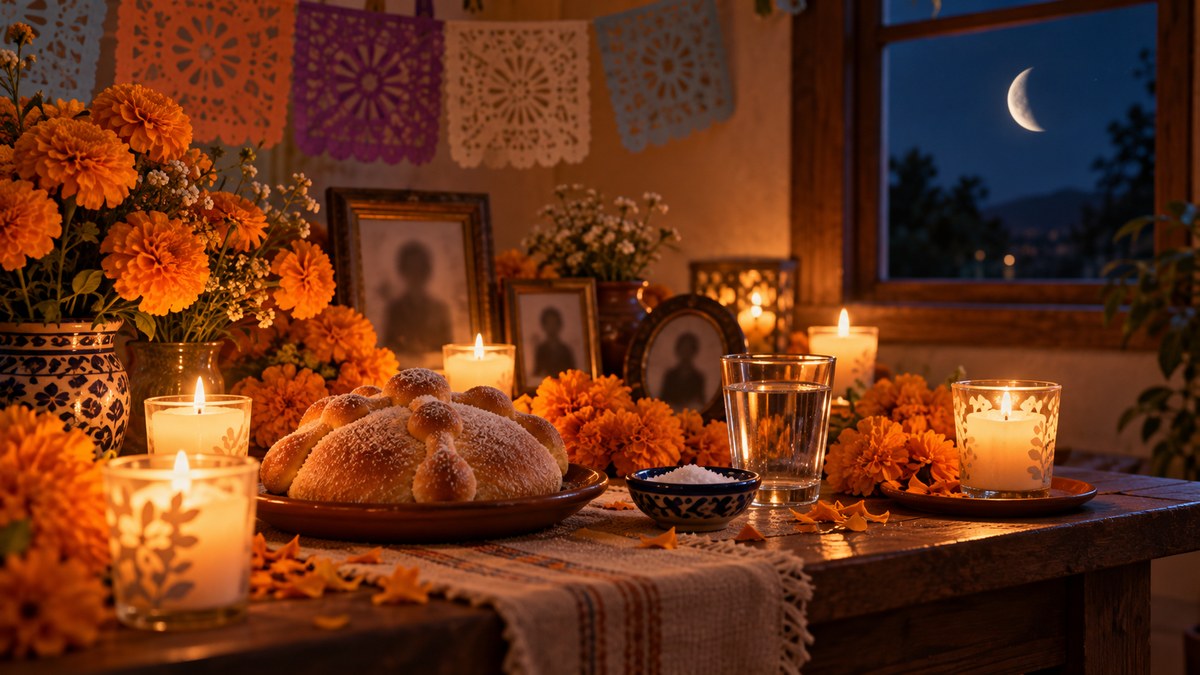
Between October 31 and November 2, two traditions overlap that speak about the same thing in different languages: Day of the Dead (Día de Muertos), a Mexican celebration to remember and welcome the departed, and Samhain, the ancient Celtic festival that marks the end of the harvest and the start of the dark half of the year. This 2026, the sky lends a hand, too: on November 1, the Moon is in its last quarter, the phase tradition associates with letting go, clearing out and saying goodbye.
Here are the dates, what each tradition means, how to build an ofrenda (altar) step by step, and a simple ritual to remember those who are no longer with us, with respect and without costumes.
Key Dates for 2026
| Date | What's Celebrated |
|---|---|
| Sat, October 31 | Samhain and Halloween night (the eve of All Saints' Day). In many Mexican homes, the final touches are put on the ofrenda. |
| Sun, November 1 | All Saints' Day. In Mexican tradition, the day for children who have passed, or “angelitos.” Moon in its last quarter. |
| Mon, November 2 | All Souls' Day, dedicated mostly to adults who have passed away. |
Customs vary by region and family: some communities also set aside October 27 and 28 for pets and for those who died tragically. There's no single “right” day to set up the ofrenda; the usual practice is to have it ready by late October and keep it up through November 2.
Day of the Dead: What It Is (and What It Isn't)
Day of the Dead is not the “Mexican Halloween.” It's a tradition of its own that blends Indigenous roots with elements of the Catholic calendar, and UNESCO recognizes it as part of the intangible cultural heritage of humanity. It isn't about fear, but about memory and reunion: it's believed that the souls of the departed return for a few hours to visit their families, and the ofrenda is the way to welcome them with their flavors, aromas and colors.
Samhain: The Other End of the Bridge
Samhain (pronounced roughly “SOW-in”) is a festival of Celtic origin that was celebrated between October 31 and November 1, halfway between the autumn equinox and the winter solstice. It marked the end of the harvest, a time of turning inward, and the start of the dark half of the year. A widely held, symbolic belief says that around these dates the “veil” between the world of the living and the world of the dead grows thinner. Much of what we now know as Halloween comes from Samhain and the eve of All Saints' Day.
Historians debate how much is known for certain about the original practices; that's why most of the Samhain rituals practiced today are modern, personal reconstructions, not ancient ceremonies preserved intact.
What They Have in Common
- Remembering those who are no longer with us and keeping their names alive.
- Light and fire: candles, votive candles or bonfires that guide or keep company.
- Food and offerings as a gesture of love.
- A moment of closure and quiet reflection as we enter the darkest time of the year in the Northern Hemisphere.
How to Build an Ofrenda Step by Step
There's no single right way: each family adapts it to its region and beliefs. Here's a simple guide to making one at home.
- Choose a quiet spot: a table, a shelf or a corner of the living room, away from curtains and drafts.
- Place the photographs of the people you want to remember, in the center or in the most visible spot.
- Add the light: one candle or votive for each person, always in a stable holder.
- Set out the basics: water, salt, flowers, bread, and some food or drink they loved.
- Decorate with color: papel picado, flowers and small objects with personal meaning.
- Take a moment to say their names out loud and share a memory.
- Clean up with care: put out the candles with a candle snuffer and share the food with your family.
What Each Element of the Ofrenda Means
| Element | Traditional Meaning |
|---|---|
| 💧 Water | Quenches the souls' thirst after their long journey. |
| 🧂 Salt | Purification and spiritual protection. |
| 🕯️ Votive candles | Their light guides the departed to the ofrenda. |
| 🌼 Marigold flower | Its color and scent mark the way; the petals are often used to make paths leading to the altar. |
| 🍞 Pan de muerto (Day of the Dead bread) | Fellowship and affection for loved ones. |
| 🖼️ Photographs | They help you remember and name each person. |
| 🍽️ Food and drink | The dishes and drinks they enjoyed in life. |
| 🍬 Calaveritas (sugar skulls) | Made of sugar or chocolate; they treat death with affection and humor. |
| 🌫️ Copal or incense | Its aroma accompanies the spiritual moment. |
| 🎏 Papel picado (cut paper banners) | Color, and a representation of air. |
Every community has its own variations: what matters is the intention and love you put into it, not reproducing an exact list.
A simple Samhain ritual to remember your loved ones
If you don't have a family tradition of building an ofrenda (altar), or you want something more intimate, this ritual takes about ten minutes and can be done on the night of October 31 or on November 1, with the Moon in its last quarter.
- Prepare your space: silence your phone, dim the lights, and set out a candle, a glass of water, and a pen and paper.
- Take three deep breaths and light the candle with the intention of remembering.
- Write a name (or several) on the paper and, underneath, one thing that person taught you or that you're grateful for.
- Say it out loud, as if that person could hear you: “Thank you for…”.
- Write a line of farewell or letting go for something you're ready to close out this year.
- Blow out the candle carefully and keep the paper somewhere special, or burn it safely in a metal or ceramic container.
The ritual doesn't “summon” anything: it's a way to sort through your emotions and give yourself permission to remember.
If you're grieving a recent loss
This time of year can stir up a lot if the loss is close. A few gentle ideas: don't pressure yourself to build a perfect ofrenda, start with a photo and a candle, let the tears come if they come, and ask someone you trust to keep you company. Talking about the person, sharing stories, or cooking their favorite dish often helps. If you feel the pain is overwhelming or keeps you from functioning for weeks, seeking professional support is a brave and sensible choice; no ritual replaces the support of a therapist or a grief group.
Dreaming of someone who has died: what does it mean?
Around these dates, many people say they dream about loved ones who have passed. Symbolic tradition often reads it as a message of farewell, comfort, or unfinished business, while psychology sees it as a reflection of memory and grief. They are not predictions or warning signs. If you'd like to explore the symbolism of your dream, try our dream meanings dictionary, and jot down how you felt when you woke up: it's the most valuable clue.
The Death card isn't what it seems
If you use tarot during these days, remember that Arcana XIII, Death, rarely announces a literal death: it symbolizes transformation, the closing of a cycle, and rebirth. It fits the energy of this season beautifully. You can read more in the 22 Major Arcana and their meanings or draw your card of the day.
What the sky says about these days
The Sun is in Scorpio until November 22, the sign astrology associates with symbolic death, transformation, and deep matters, which is why this season feels so ritual. In addition, Mercury retrograde, which lasts until November 13, is read as an invitation to revisit the past, and the last quarter Moon of November 1 favors closing things out and getting organized. The new moon on the 9th opens the way for fresh intentions. Check out the November 2026 moon calendar and the November horoscope for all 12 signs.
Mistakes worth avoiding
- Treating a living tradition like a costume. If it isn't yours, take part with curiosity and respect, not as a caricature.
- Leaving candles unattended, especially near papel picado, curtains, kids, or pets.
- Burning copal or incense in closed spaces around people sensitive to smoke; always ventilate.
- Turning it into an obligation. If you're not feeling up to it this year, a candle and a name are enough.
Information on traditions gathered from cultural and institutional sources; customs vary by region and family. Rituals and astrology are symbolic and meant for well-being. If you use candles, never leave them burning unattended.
For next month, check out the November 2026 moon calendar, featuring the Beaver Supermoon and the Leonid meteor shower.
✦ Try it now Simple rituals and spells → Choose your intention (protection, abundance, or love) and get a ritual using materials you already have at home.
Frequently asked questions
When is Day of the Dead celebrated in 2026?
Mainly on November 1 (All Saints' Day, associated with children who have passed) and November 2 (All Souls' Day, dedicated to adults). The ofrenda is usually ready by the end of October.
What's the difference between Day of the Dead and Halloween?
Day of the Dead is a Mexican tradition with Indigenous and Catholic roots, centered on remembering and welcoming those who have passed. Halloween comes from the eve of All Saints' Day and the Celtic festival of Samhain, and today it's a more festive, popular celebration.
What is Samhain, and when is it celebrated?
It's an ancient Celtic festival that marks the end of the harvest and the start of the dark half of the year. It's celebrated between October 31 and November 1. Most modern rituals are contemporary reconstructions.
What goes on a Day of the Dead ofrenda?
Photographs, candles, water, salt, cempasúchil (marigold) flowers, pan de muerto, the person's favorite food and drink, papel picado, and in many cases copal or incense. Each family adapts it to its own customs.
Is it a good date for a farewell ritual?
Yes. On November 1, 2026, the Moon is in its last quarter, a phase tradition links to letting go and getting organized, and the Sun is still in Scorpio. It's all symbolic: what matters is your intention and taking care of yourself.
What did you think of this article? Tell us about your experience.
Thanks for your feedback!