How to Find Your Aura Color Without a Special Camera
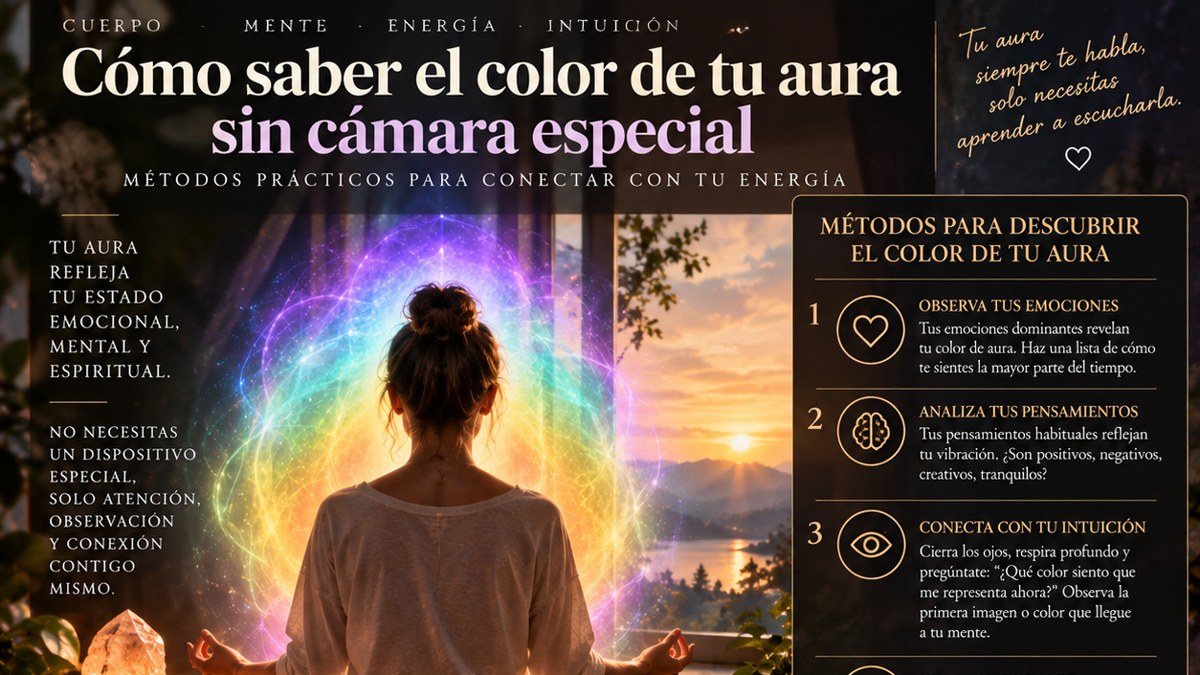
Although there are specialized cameras that claim to capture the aura in photographs, you don't need any expensive equipment to start exploring your own energy field. With practice and patience, aura perception is a skill that many people develop gradually.
The Mirror Technique
Stand in front of a mirror in dim light with a neutral background behind you (a white or light-colored wall works well). Relax your gaze rather than focusing directly, and observe the outline of your head and shoulders without fixing your eyes on one exact spot. With practice, some people begin to notice a faint halo of color around the outline.
The hands technique
Bring your palms together and slowly separate them a few inches in front of a dark background, with soft lighting. Many people describe sensing a kind of haze or subtle vibration between their hands — a good first exercise to sensitize yourself before trying to perceive the full-body aura.
Pay attention to your intuition, not just your eyesight
Perceiving the aura is not always a purely visual phenomenon. Many people "feel" the color before they see it, as an intuitive impression that arises spontaneously. Trust that first impression instead of dismissing it because it isn't a sharp, well-defined image.
Consistent practice makes the difference
Like any intuitive skill, aura perception improves with repetition. Spend a few minutes several times a week on these exercises, without pressuring yourself to get immediate results, and over time you will notice an increasingly refined energetic sensitivity.
The Colored Background Method
A little-known technique is to observe yourself in front of different solid-colored backgrounds (a cloth, a painted wall) and notice which one makes you feel most "in harmony" visually, almost as if the color blends effortlessly with your energy instead of competing with it. Many people discover a clear affinity for a particular color this way, one that surprisingly matches what other methods of aura perception describe.
Energy journal: your own record of patterns
Keeping a small journal for 21 days, noting each night your dominant emotional state and any color you felt was associated with your energy that day, is one of the most reliable ways to identify your usual aura (the one that predominates most of the time) as opposed to your passing auras (the ones that appear only at specific moments of stress, intense joy, or fatigue). Over time, this record reveals patterns that no one-off meditation exercise can show on its own.
When two people perceive different colors in you
It's common that when you ask several people you trust what color they sense in you, the answers don't match exactly. This doesn't invalidate the exercise: each person perceives another's aura filtered through their own sensitivity and their specific relationship with you, so a relative may perceive your warmth (green or pink) while a colleague perceives your mental focus (blue or yellow) — both perceptions can be valid at the same time, reflecting different layers of the same energy.

Frequently asked questions
What is the aura, and can you really see it?
According to esoteric traditions, the aura is a field of subtle energy that surrounds the body and is said to reflect emotional and spiritual states. Everyone interprets it in their own way, so it's best to approach it with curiosity and an open mind.
How can I see my aura at home?
A common practice is to stand in front of a light-colored wall in dim light and look at your outstretched hand without straining your eyes, with a soft, unfocused gaze. Breathe calmly and notice whether you perceive a luminous outline. It's an exercise in attention and relaxation; results vary from person to person and are not guaranteed.
What do aura colors mean?
In the esoteric tradition, each color is associated with a meaning: red with vitality, blue with calm and communication, green with balance, yellow with creativity, and violet with intuition. These are symbolic interpretations, not universal ones, and they vary by school. Use them as inspiration for reflection, not as a diagnosis.
How long does it take to learn to see the aura?
There's no fixed timeline: it depends on consistency and on how you approach the practice. Some people say they perceive something in the first few sessions, and others never do. What helps is practicing regularly, in a calm environment, without pressuring yourself. I'd rather invite you to explore without expectations than promise you specific results.
Do I need a special gift to see my aura?
Esoteric traditions often say that anyone can develop this sensitivity with practice, without needing a special gift. Even so, I can't promise you results. What matters is to enjoy the process, keep an open mind, and not get frustrated if you don't see colors; the experience is very personal.
What did you think of this article? Tell us about your experience.
Thanks for your feedback!