The Four Hand Shapes in Palmistry
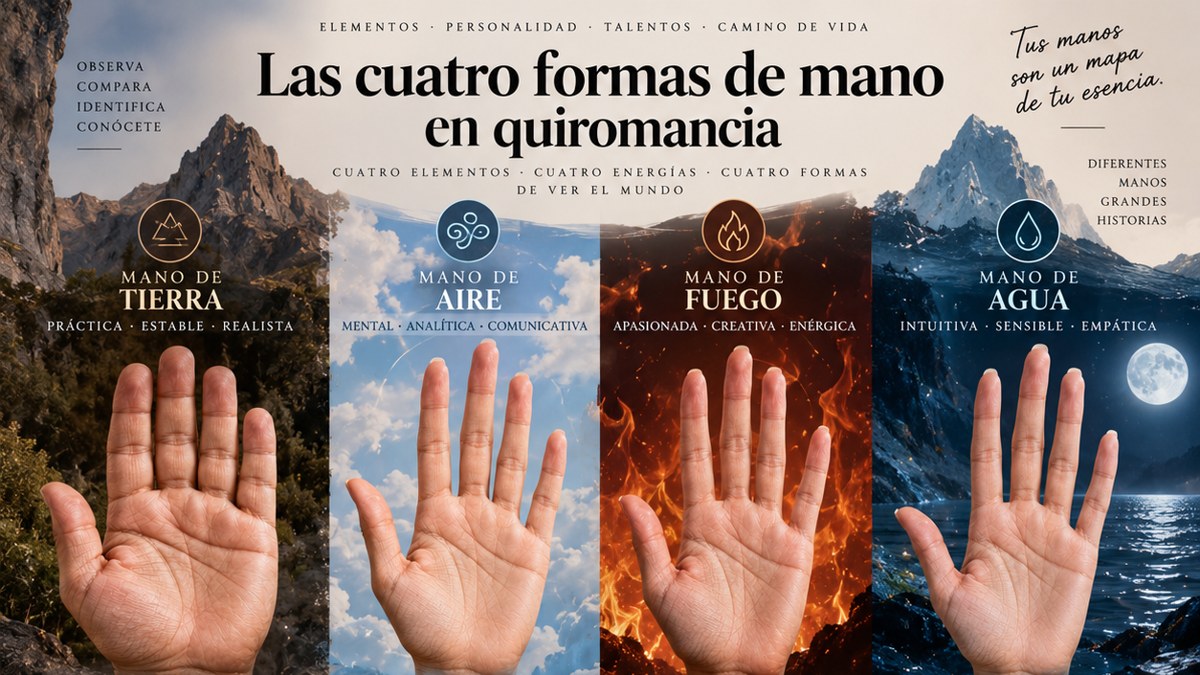
Even before looking at the lines of the palm, palmistry observes the overall shape of the hand and classifies it according to the classic four elements, offering a first layer of information about a person's temperament.
Fire Hand
Elongated palm with short fingers. It corresponds to energetic, spontaneous, passionate personalities with great initiative but a certain tendency toward impatience. They tend to be natural leaders who act first and reflect later.
Earth hand
A square palm with short fingers and often thicker skin. It reflects practical, stable, reliable people who are deeply connected to the material and the tangible. They value routine and security, although they may resist change more than necessary.
Air Hand
Square palm with long fingers. It's associated with curious, communicative, social minds that have a knack for ideas and interpersonal relationships. Their main challenge is usually turning so many ideas into concrete action.
Water hand
An elongated palm with equally long, delicate fingers. It corresponds to sensitive, intuitive, emotional natures with great empathy for others. They need to learn to protect their energy so they don't absorb other people's emotions excessively.
By combining the overall shape of the hand with a detailed analysis of its lines, you get a much richer and more nuanced palmistry reading than by analyzing either aspect on its own.
How to identify your hand shape in seconds
Hold out your dominant hand with your fingers together and notice two things: the shape of the palm (is it more square or more elongated?) and the length of the fingers relative to the palm (are they short or noticeably long?). A square palm with short fingers indicates earth; a square or rectangular palm with long fingers indicates air; a rectangular palm with medium to short fingers indicates fire; and an elongated or oval palm with long, flexible fingers indicates water. With practice, identifying the basic shape takes just a few seconds.
Uncommon combinations: mixed hands
Not every hand fits neatly into a single category — it's quite common to have, for example, a square palm (earth) with long fingers (more typical of air). These "mixed hands" point to a personality that combines qualities of both elements: in the example above, someone practical and work-oriented like earth, but with a curious, intellectually restless mind like air. Far from being an exception to the rule, these combinations are the most common in real-world palmistry practice.
Hand shape and career choice
Some palmists use hand shape as an additional clue to guide career decisions. Earth hands tend to feel fulfilled in practical, tangible trades (construction, cooking, farming, finance); air hands in communication, teaching, or technology; fire hands in leadership, sales, sports, or any field that lets them express their dynamic nature; and water hands in the arts, therapy, caring for others, or any calling that involves deep emotional sensitivity. Of course, this is only a symbolic guide — it doesn't replace your own interests and real-life experience.
Fingers in palmistry: what is attributed to them
The shape of the hand isn't read from the palm alone: the fingers add a second layer of nuance. According to tradition, each finger is linked to a planet, just like the mounts of the palm. The index finger is associated with Jupiter and self-confidence; the middle finger with Saturn and responsibility; the ring finger with Apollo and creativity; and the pinky with Mercury and communication. The thumb, separately, is related to willpower and determination.
It helps to look at relative length: an index finger longer than the ring finger is described, symbolically, as a character inclined to lead; a longer ring finger, as a more creative, risk-loving profile; a pinky reaching the height of the top joint of the ring finger, as an ease in self-expression. These are traditional conventions that vary between schools and aren't meant to measure any real aptitude.
How to measure your hand with a ruler
If you want a more objective classification than going by eye, you can do this test in two minutes. Extend your hand with your fingers together on a table. Measure the palm from the wrist crease to the base of the middle finger, and compare it to the length of the middle finger itself. If the middle finger is clearly shorter than the palm, it is called short fingers; if it is equally long or longer, long fingers. Then look at the palm: if its width and length are similar, it is square; if it is clearly longer than it is wide, it is elongated.
With those two observations you can already place yourself: square palm and short fingers, earth; square palm and long fingers, air; long palm and short fingers, fire; long palm and long fingers, water. The exact criteria vary from one school to another, so treat the result as guidance rather than a verdict.
Hand shape and zodiac sign: are they related?
Since the classification uses the four elements, many people wonder whether their hand matches their sign. It doesn't have to. Someone with a fire sign can have a water hand, and the tradition sees that as an interesting nuance, not a contradiction. If you'd like to explore how the elements are distributed across the zodiac, check out the article on the elements of the zodiac, and to get to know your sign in more detail, you can visit Scorpio (the Sun passes through this sign in November) or the page for any of the other eleven.
Examples of combined readings
Imagine an air hand (square palm, long fingers) with a long, straight head line. The symbolic reading would be of a curious, communicative person with an orderly mind; the traditional challenge of air, putting ideas into practice, is balanced by the straight head line, which suggests methodical thinking. Another example: a water hand with a deep, curved heart line, which is interpreted as marked sensitivity and great empathy; the symbolic advice would be to take care of your emotional boundaries.
In both cases the idea is the same: the shape gives the underlying temperament and the lines add the nuances. That's why it's best to read the shape first and then the detail of the heart line and the others.
Common mistakes when classifying a hand
The first is measuring with the fingers spread or bent; they should always be together and straight, without forcing them. The second is forgetting that the hand changes a bit with age, cold, or swelling, so it's best to measure with your hand at room temperature. The third is taking the shape as a fixed label: tradition presents it as a tendency, not a definition of who you are. And the fourth is mixing criteria from different schools without realizing it; pick one and stick with it.
Once you've identified your shape, the natural next step is the Portal Místico palmistry tool, which guides you through your own palm, or the complete guide to the lines of the hand.

Frequently asked questions
What are hand shapes in palmistry?
Palmistry classifies the hand according to the shape of the palm and the length of the fingers to describe character traits and temperament. It is the first step before reading lines or mounts.
What are the four hand types according to palmistry?
The tradition distinguishes four shapes tied to the elements: earth, air, fire, and water. They differ by combining a square or elongated palm with short or long fingers.
How do I identify the shape of my hand?
Look at your palm, from the wrist to the base of the fingers, and compare its length to its width: if they are similar, it is square; if the length dominates, it is elongated. Then compare the length of the fingers to that of the palm. That combination tells you your element: earth, air, fire, or water.
What does it mean to have an earth hand?
It's described as a square palm with short fingers. Symbolically it's associated with practicality, steadiness, a sense of reality, and attachment to the tangible. Its less favorable side would be stubbornness or resistance to change. If you're interested, you can compare this profile with the earth signs (Taurus, Virgo, and Capricorn) in our zodiac section.
What does it mean to have an air hand?
It is recognized by a square or rectangular palm with long fingers. Palmistry links it with curiosity, communication, an analytical mind, and a need for variety. As something to watch out for, a certain restlessness or excess of rationality is mentioned. You can compare it with the air signs (Gemini, Libra, and Aquarius) and see if you identify with both.
How do I determine the shape of my hand?
With your fingers together, compare the middle finger to the palm (from the wrist to the base of that finger) to see whether your fingers are short or long, and check whether the palm is square or elongated. The criteria vary between schools.
Does my hand shape match my zodiac sign?
Not necessarily. Someone with a fire sign can have a water hand. Tradition treats it as a nuance, not a contradiction.
Does the shape of the hand change over time?
The basic proportions stay the same, but cold, swelling, or age can change the appearance a little. It's best to measure with your hand at room temperature.
What did you think of this article? Tell us about your experience.
Thanks for your feedback!