Lines of the Hand: What Each One Means and How to Read Them
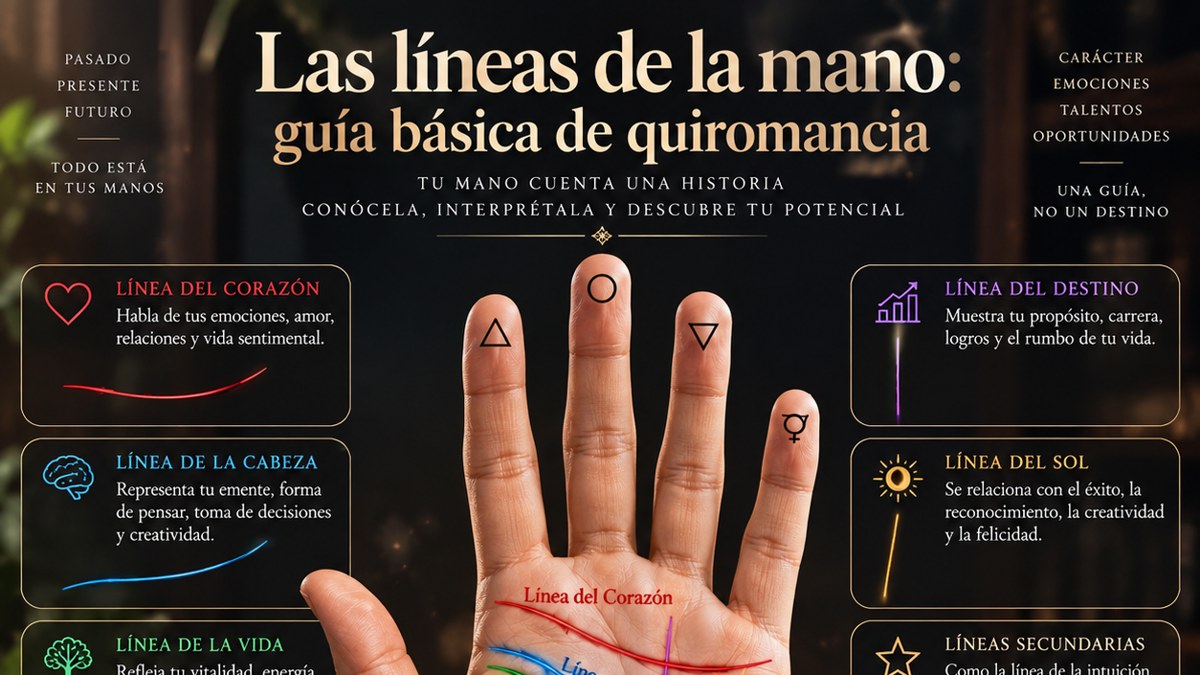
The lines of the hand are the starting point of palmistry, the symbolic tradition of reading the palm. If you've landed here looking for "lines of the hand," "how to read your palm," or the meaning of a specific line, this guide brings the essentials together in one place: which line is which, where it's located, what it represents according to tradition, what the mounts of the palm are, and how to do your own reading step by step, with no prior experience needed.
A heads-up before you begin: everything you will read is symbolic and for entertainment. According to tradition, the palm works as a mirror for reflecting on your character and your life stages; it does not predict illness, length of life, money, or outcomes, and it does not replace any medical, legal, or financial consultation. If anything in the guide sounds like a verdict, take it as a metaphor and not as a fact.
How to Prepare to Read a Hand
Before looking at the lines, it helps to settle on a simple method. With these steps, your reading will be clearer and less dependent on the impression of the moment.
- Choose good light. Natural light from a window is best. In warm, dim light the fine lines disappear.
- Relax your hand. Open it without forcing it. If you stretch your fingers too much, the lines tighten and look straighter; if you close your fist, they wrinkle and false lines appear.
- Decide which hand to read. A widespread convention uses the non-dominant hand as the "potential" you were born with and the dominant hand as what you've shaped through your decisions. Other schools see it the other way around, so the most useful approach is to look at both and compare.
- Start with the big picture. First the overall shape of the hand and the three or four main lines; then the secondary lines and the mounts. Save the tiny lines for last.
- Jot down words, not sentences. Write one or two words per line ("deep," "broken," "curved"). Calm interpretation comes later.
If you want help getting started, you can use the Portal Místico palmistry tool, which guides you with your own palm. And to understand the size and shape of your fingers, see the four hand shapes in palmistry, which provide the general framework within which the lines are read.
The Main Lines of the Hand
On almost every palm, three main lines can be distinguished: the life line, the head line, and the heart line. Many guides add a fourth, the fate line, which doesn't appear on every hand. None is interpreted in isolation: they are read together, so that each line adds nuance to the others.
Life line
It starts between the thumb and index finger and wraps around the base of the thumb, curving toward the wrist. It's the most misunderstood line. Contrary to what's repeated online, it doesn't measure how long you'll live: tradition associates it with vitality, physical energy, and the way you face change. A long, well-defined line is described as a sign of constancy and endurance; a thin or interrupted line is read as stages of change or reorganization, never as a warning. A wide curve around the thumb suggests, symbolically, an expansive character; a tight curve, more reserve and care with one's energy.
Head line
It crosses the palm horizontally, below the heart line, and often starts near the life line. It represents the mind: how you think, make decisions, and solve problems. A long, straight line is associated with logical, practical thinking; a line that curves down toward the lower edge of the hand, with imagination and creativity. A short line doesn't mean "little intelligence"; tradition reads it as a direct mind that prefers to get to the point. If the line seems to split in two at the end, some palmists speak of the ability to combine the analytical with the creative.
Heart line
It's the uppermost line, just below the fingers, and it runs across the palm from the outer edge to the area between the index and middle fingers. It speaks of the emotional world: how you express affection, how you bond, and what you look for in relationships. The deeper and clearer it is, the more intense the emotional life is described to be; a line with many branches, more social sensitivity. Where it ends changes the nuance: toward the index finger it's linked to high ideals in love, and between the index and middle fingers, to a balance between head and heart. You'll find a more extensive analysis in our article on the heart line and love life.
Fate line
It's a vertical line that rises from the base of the palm toward the middle finger. Not everyone has it, and its absence doesn't mean anything negative. Symbolically it's associated with a sense of direction, vocation, and the way you relate to your responsibilities. A pronounced line is read as a defined path; a line that appears late, as a change of course or a purpose that becomes clearer over the years. When several lines cross to form the letter M on the palm, popular tradition speaks of a highly sought-after combination: what it means to have the letter M on your hand.
The secondary lines
Beyond the main lines, there are lines that appear only on some hands and add nuance. Here are three of the most commonly asked about.
The sun line (or Apollo line) runs parallel to the fate line, toward the ring finger. According to tradition it is associated with creativity, recognition, and satisfaction with what you do. The intuition line is a curved line that runs along the edge of the palm, on the side opposite the thumb, and not everyone has it. It is symbolically linked to sensitivity, perception, and hunches; if you are looking for it because the question that interests you most is "intuition line in palmistry," remember that its appearance does not prove any special ability. The relationship lines (sometimes called marriage lines) are small horizontal marks on the edge of the palm, below the pinky; they are read as moments of important bonds, not as a number of partners or as a prediction of a partnership or breakup.
The Mounts of the Hand
The mounts are the fleshy, slightly raised areas of the palm. In the tradition, each one is named after a planet and associated with a set of qualities. Notice whether they're full, flat, or very pronounced: a pronounced mount intensifies, symbolically, the qualities associated with it.
- Mount of Venus (base of the thumb): vitality, affection, a taste for pleasure and beauty.
- Mount of Jupiter (base of the index finger): ambition, leadership, self-confidence.
- Mount of Saturn (base of the middle finger): discipline, responsibility, a tendency toward reflection.
- Mount of Apollo or the Sun (base of the ring finger): creativity, sociability, a search for recognition.
- Mount of Mercury (base of the pinky): communication, wit, business skill, and ideas.
- Mount of the Moon (edge opposite the thumb, lower area): imagination, intuition, inner world.
- Mounts of Mars (two areas, one above the life line and another below the mount of Mercury): courage, drive, and the ability to defend what's yours.
These names come from traditional astrology. If you're interested in that connection, you can explore the zodiac sign that represents you best or calculate your birth chart to see how the two disciplines talk to each other.
Step-by-step reading example
Imagine a palm with a deep life line that curves broadly, a slightly curved head line, and a heart line that ends between the index and middle fingers. A symbolic reading would be this:
- A broad life line suggests steady energy and an easy time recovering after changes.
- A curved head line points to an imaginative mind, more creative than strictly logical.
- A heart line that ends between the index and middle fingers speaks of a balance between feeling and reason.
- All in all: a person who combines creativity and emotional stability. That description is an invitation to ask yourself whether you recognize yourself in it, not a diagnosis.
Common mistakes when interpreting the lines
The first is reading a single line and drawing conclusions. Each line adds nuance to the others, and an isolated reading is usually misleading. The second is dramatizing breaks: a cut line or one with islands doesn't foretell anything negative; tradition associates it with transitions. The third is believing the palm is fixed: the main lines stay fairly stable, but they can deepen, soften, or add small branches over the years, reflecting what you've lived through. The fourth is counting small lines as if they were an exact number of something (children, partners, trips): that kind of reading has no solid basis, even within the tradition itself.
If you want to follow the evolution of your hand, a practical idea is to photograph your palm once a year in the same light and compare. It works like a small personal journal, with no predictive value.
How to keep learning
Palmistry is learned through practice and observation. A good progression is to start with the three main lines, then add the fate line and the intuition line, and finally the mounts. When you feel comfortable, try the palmistry tool to compare your notes with a guided reading, and explore the resources section to go deeper with books and materials. Remember that, as in any symbolic discipline, the value lies in the reflection it sparks in you and not in closed answers.
When the life, head, and heart lines join with the fate line, they can form a highly sought-after figure: here we explain what it means to have the letter M on your hand.
✦ Try it now Read the lines of your hand → Photograph your palm with our palmistry tool and find out what your main lines say.
Frequently asked questions
What are the main lines of the hand, and what do they mean?
There are usually four main lines: life, head, heart, and fate. Traditionally, the life line is associated with vitality, the head line with the mind, the heart line with emotions, and the fate line with personal direction.
Does the life line indicate how long you'll live?
No. The life line wraps around the base of the thumb and in palmistry is interpreted as energy, vitality, and important changes, not as length of life. A short or thin line doesn't predict anything negative. I recommend taking it as a symbol and not as a medical prognosis or a literal fact.
What does the head line say about how I think?
It crosses the palm through the center and is associated with thinking, creativity, and how you make decisions. A long line is interpreted as an analytical mind and a curved one as imagination. These are traditional, symbolic readings that vary by school.
Which hand should you read, the right or the left?
It depends on the tradition. One school says the dominant hand shows what you do with your life and the other what you were born with; another proposes reading the left for the innate and the right for the acquired. The usual approach is to look at both and compare them. These are symbolic criteria, not universal rules.
How do you read the lines of the hand step by step?
With natural light and your hand relaxed, first observe the overall shape and the three main lines (life, head, and heart), then the fate line and the minor ones, and finally the mounts. Jot down one or two words per line and compare both hands. It is a symbolic reading for entertainment.
What does the intuition line mean in palmistry?
It's a curved line on the edge of the palm, opposite the thumb, that not everyone has. According to tradition it's associated with sensitivity and perception, but its presence or absence doesn't prove any special ability.
What are the mounts of the hand?
These are the fleshy areas of the palm, named after planets (Venus, Jupiter, Saturn, Apollo, Mercury, Moon, and Mars). A more developed mount symbolically intensifies the qualities tradition attributes to it.
Do the lines of the hand change over time?
The main ones stay fairly stable, but they can deepen, soften, or add small branches over the years. That's why some readers photograph their palm every so often, like a personal journal with no predictive value.
What did you think of this article? Tell us about your experience.
Thanks for your feedback!