What the Heart Line Reveals About Your Love Life
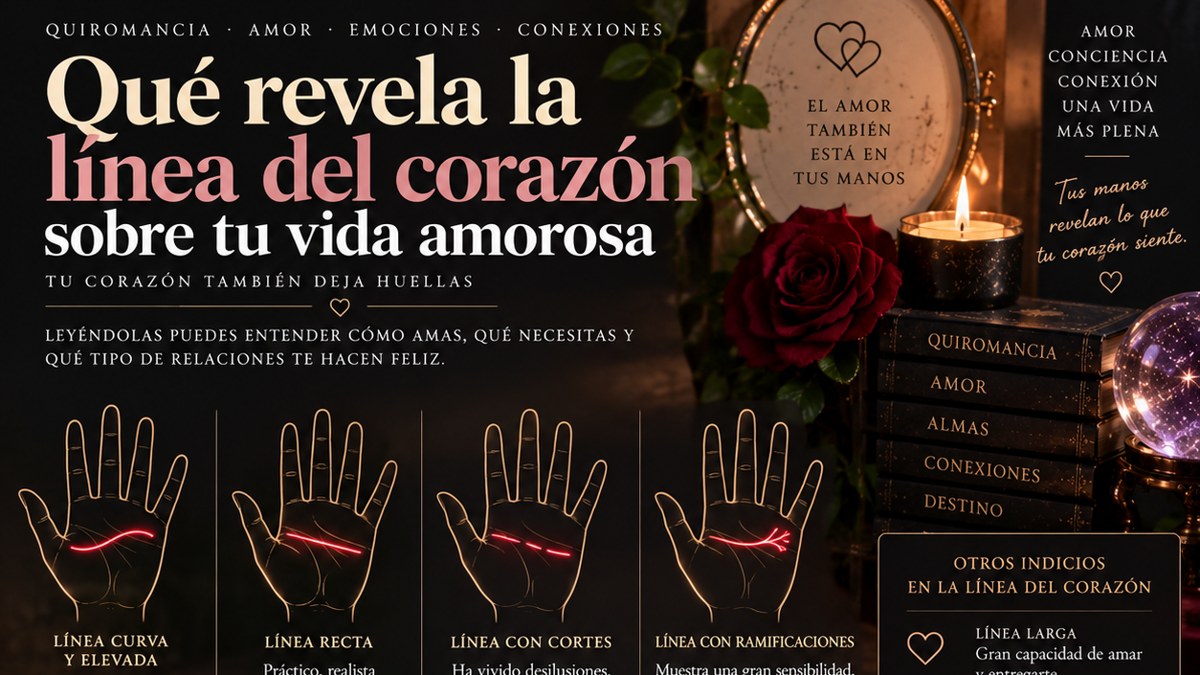
Of the three main lines of the palm, the heart line is the one that sparks the most curiosity when it comes to love. Its path offers clues about your particular way of loving, far beyond a simple "yes or no" about your love life.
The starting point matters
If the line starts right below the index finger, you tend to idealize love quite a bit and look for a deep, meaningful connection. If it starts closer to the center, between the index and middle fingers, you lean toward a more balanced, realistic kind of love. A start below the middle finger, on the other hand, is associated with people who are more emotionally independent and need their own space even within a relationship.
Long line vs. short line
A long heart line, one that extends well toward the edge of the palm, usually indicates someone expressive, generous with affection, and willing to give a lot in their relationships. A shorter line doesn't imply coldness, but a more selective style: few connections, but very intense and meaningful ones.
Curved, straight, or wavy
A curved line that rises toward the fingers suggests a warm, demonstrative nature. A straight, horizontal line points to someone more reserved, who expresses affection through actions rather than words. Waves along its path may indicate several significant romantic experiences throughout life.
Small marks, big meanings
Upward branches at the end of the line are usually interpreted as signs of emotional optimism, while crosses or isolated islands may reflect periods of doubt or challenge in the realm of affection — moments, not final verdicts.
Where it begins and where it ends: the complete map
Besides the starting point, the end point of the heart line provides valuable information. A line that ends right between the index and middle fingers suggests a romantic approach balanced between reason and passion. If it curves upward, toward the index finger itself, it signals romantic idealism and high standards in a partner. If it ends more horizontally, almost straight toward the edge of the hand, it may indicate a person who greatly values independence even within a committed relationship.
Comparing both hands in love
As with the other lines, comparing the heart line of your non-dominant hand (your innate emotional potential) with that of your dominant hand (how you actually love, shaped by your experiences) can be revealing. If both lines are very similar, it's a sign that you live your love life in harmony with your deepest nature. If they're markedly different, perhaps your past experiences have led you to love in a way that doesn't always match what your heart originally seeks.
Palmistry and emotional self-knowledge
Beyond prediction, reading your own heart line can be a valuable exercise in introspection: it invites you to honestly ask yourself how you give and receive love, which patterns repeat in your relationships, and which emotional wounds may still be waiting to be tended. No line determines your love destiny — but it can illuminate patterns worth observing with more awareness.
Where the heart line is and how to find it
If this is the first time you're looking at your palm, the heart line is the easiest to find: it's the top line, the one closest to the base of the fingers. It runs across the palm more or less horizontally, from the edge of the hand on the pinky side toward the thumb side. To see it clearly, relax your hand with the palm open and look for natural light; if you curl your fingers slightly, the line stands out more.
A useful trick: rest your fingertip on the outer edge of the palm, under the pinky, and trace the highest line you can see. That's the heart line. The one right below it, also horizontal, is usually the head line, and together they form a good part of the M on the palm of the hand that people look for so much.
Deep, thin, or double: what's said about its appearance
According to traditional palmistry, the thickness and sharpness of the line speak to the intensity with which one experiences affection. A deep, well-marked line is associated with intense emotions and bonds that are felt strongly. A thin or faint line is read as a more discreet emotional style that prefers calm over drama. And a very faint line is almost always simply due to skin type or how the hand creases; there's no need to give it more weight than it deserves.
Some hands show a doubled heart line, with a parallel stroke very close by. Tradition interprets this as a generous, affectionate nature with a lot of love to give. It's a symbolic reading: it doesn't mean you'll have more or fewer relationships, or that your love life will turn out one way or another.
Branches, chains, and small marks
Many people find branches on the heart line that go upward, downward, or form a kind of chain. The usual reading is this: branches that rise toward the fingers are associated with optimism and emotional enthusiasm; those that descend toward the center of the palm, with moments of reflection or emotional weariness; and a line made up of small links, with a sensitivity that shifts easily depending on the environment.
Islands (small ovals in the line) and breaks are interpreted as periods of transition or doubt, never as a sentence. A broken line, moreover, can reappear further along, and tradition reads this as one stage closing and another beginning.
How to Read the Heart Line in a Relationship
A fun use of palmistry is to compare, with no pretense of diagnosis, the heart lines of two people. Start with simple questions: do both lines end at the same point? Is one more curved and expressive, and the other straighter and more reserved? If the lines are very different, the symbolic reading suggests that each person expresses affection in their own way, and that talking about what each one needs can help. If they're similar, it's said to indicate a similar emotional rhythm.
This does not predict whether a relationship will last. To keep exploring the topic for fun and through symbolic tradition, you can check out the love compatibility of each sign or do a reading with the love tarot.
Step-by-step reading example
Imagine a long, curved heart line that ends between the index and middle fingers, with a small branch pointing up at the end. A traditional symbolic reading would be: the length and curve suggest an expressive, warm person; the ending between both fingers, a balanced approach between reason and feeling; and the upward branches, an optimistic attitude toward relationships. To complete the picture, it's worth looking at the head line and the other lines of the hand as well, because none is interpreted in isolation.
Common myths about the heart line
There are several ideas that keep circulating online and have no support even within the tradition itself. The first is that the heart line shows how many partners you'll have. It doesn't. The second is that it predicts infidelity, a breakup, or the moment you'll meet someone: these are claims no one can back up, and it's wise to distrust any reading that offers them as certainties. The third is that a short or broken line is "bad." Symbolically, it describes styles and stages, not destinies.
Finally, remember that any issue involving emotional health, relationships, or complicated romantic situations deserves a real conversation with the person involved or with a professional when needed. Palmistry is a space for reflecting calmly, not a substitute for that.

Frequently asked questions
What is the heart line on the hand?
At Portal Místico we explain it through palmistry: it's the line that crosses the palm below the fingers and is associated with emotions, the way we love, and emotional bonds. It's a symbolic, traditional reading, meant for personal reflection and not as a diagnosis or a fixed prediction.
Where is the heart line, and how do I identify it?
It is the horizontal line closest to the base of the fingers. It usually starts at the edge of the palm, below the pinky, and runs toward the index or middle finger. We recommend looking at your hand in good light with the palm relaxed to tell it apart from the head line, which sits below it.
What does it mean to have a long, curved heart line?
According to the palmistry tradition, a long, curved line is interpreted as an expressive, warm person who is open about showing their feelings. It's a symbolic reading, not an absolute truth.
What does a short or straight heart line indicate?
In palmistry, a straight or short line is usually associated with a more reserved or practical character in emotional matters, one that prefers actions to grand gestures. It is neither good nor bad: these are classic symbolisms. We invite you to read them as personality traits, not as verdicts on your love life.
What do breaks, cuts, or islands in the heart line mean?
Tradition links them with moments of emotional intensity, changes, or emotional wounds that marked the person. They are symbolic interpretations, not provable facts.
How do I know which one is my heart line?
It is the highest horizontal line on the palm, the one closest to the base of the fingers. With a relaxed hand and good natural light it is easy to make out; the head line sits just below it.
Does the heart line predict how many partners I'll have?
No. It's a popular belief with no backing, even within the tradition itself. Palmistry interprets it as an emotional style, in a symbolic and entertainment-oriented way.
What do branches on the heart line mean?
According to tradition, branches that rise are associated with emotional optimism and those that descend with moments of reflection. These are symbolic readings and vary between schools.
What did you think of this article? Tell us about your experience.
Thanks for your feedback!